
Boost Your Website’s Speed and Security with a Content Delivery Network (CDN)

When boosting your website’s speed and security, a key tool to consider is a Content Delivery Network (CDN). A CDN helps your site load faster and minimizes the risk of downtime, improving both user experience and search engine rankings. A CDN adds an extra layer of security by protecting against traffic surges and malicious attacks.
Let’s explore what exactly a Content Delivery Network is and how it can elevate your website’s performance and security.
What is a content delivery network?

A Content Delivery Network (CDN) is a large group of interconnected servers spread out geographically that work together to provide fast delivery of internet content.
When someone visits your website, instead of loading everything from one central location, a CDN stores copies of your content on servers in different places. This way, when someone tries to access your site, they get it from the server that’s closest to them. This makes your site load faster, no matter where your visitors are.
It is similar to ordering a package from a nearby warehouse instead of waiting for it to be shipped from across the country—it’s quicker and more efficient! As a bonus, it also helps to protect your site from too much traffic or cyberattacks.
Here is a breakdown of how they help your website:
1. Cache your content making your website load faster
CDNs cache your content, creating stored copies of your data at strategically placed points of presence (POPs). When a user requests your page, they receive the cached version from the nearest POP, drastically reducing load times.
2. Reduce the bandwidth used by your site
By serving cached content, CDNs minimize the need for repeated requests to your hosting service. This translates to reduced bandwidth usage, making your website more efficient and cost-effective.
Caching is the storing of copies of your data. In the case of a content delivery network, when a visitor first lands on your site, a request is sent to your hosting service which shows your page. At the same time, a copy of that page is sent to the CDN point of presence (POP) that is closest geographically to the visitor. That copy of your page is stored as a “cached file”.
The next time that visitor, or someone visiting from that same location makes the request to see your page, this cached version will be seen rather than the one sitting on your hosting service’s server.
This means less bandwidth is used because the request hasn’t been sent back to your hosting service. It only went as far as the content delivery network.
3. Prevents interruptions in service with Dynamic Acceleration
Dynamic acceleration reduces the server response time for dynamic web content request because of the CDN server that acts as the go between the web page and the visitor.
Dynamic web content is the content on your page that is personalized and adapts based on the data you have about the user and on the access time. The goal of dynamic content is to deliver an engaging and satisfying online experience for the visitor.
Think of things like an email that is personalized with the user’s name. That name has been retrieved from a database and inserted automatically making the receiver feel like it was crafted just for them.
4. Edge Logic Computations for Improved Performance
CDNs simplify communication between clients and servers through edge logic computations. This not only enhances website performance but also alleviates the compute requirements on origin servers, leading to faster load times.
Content Delivery Networks are about more than just speed
CDN offers more than just speed. Other benefits include:
1. Enhanced Security
Acting as a security wall, CDNs require requests to pass through security certificates before accessing your website. This added layer of protection safeguards your site from potential threats.
2. Resilience Against DDoS Attacks
CDNs, with their multitude of servers, can effectively distribute the load during distributed denial-of-service (DDoS) attacks. This resilience minimizes the impact on the origin server, ensuring uninterrupted service for your users.
How does a content delivery network benefit your website?
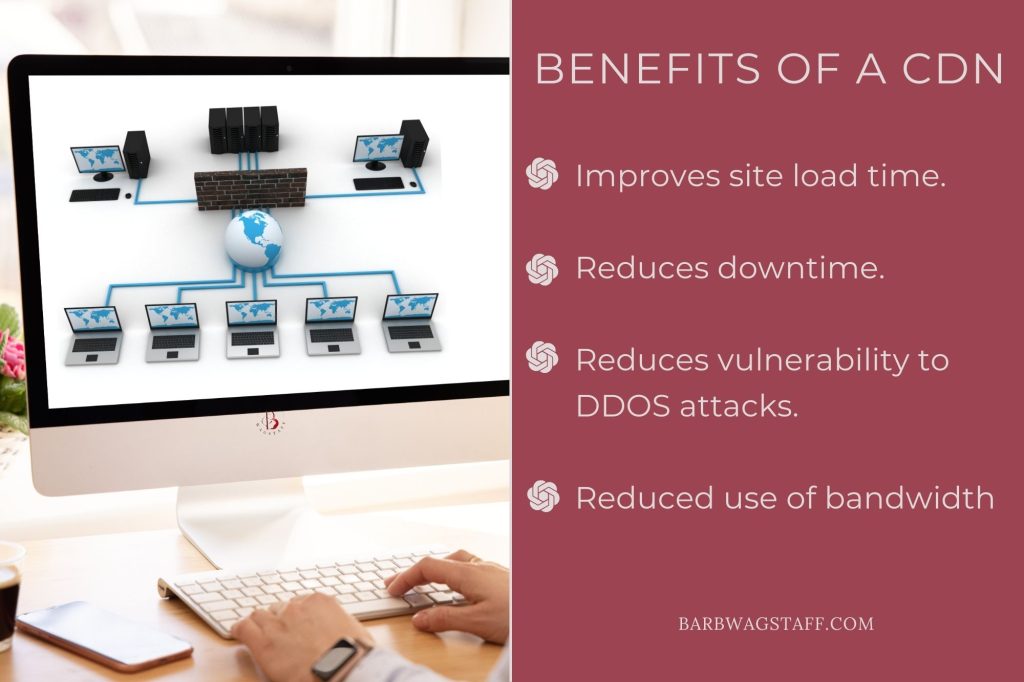
Content delivery networks, as I have said, improve your site load time. The faster your site loads, the more likely visitors are to stay on your website and engage with more content.
By using things like caching, dynamic acceleration, and edge logic computations, CDNs reduce the amount of data that your site hosting service must provide. This can translate to savings for you as most hosting packages are contingent in one way or another on how much bandwidth your site requires.
Because a content delivery network uses a large group of servers, your site is better able to withstand large amounts of traffic or hardware failures making it more reliably available to your users.
A CDN also improves the security of your website. Through things like security certificates, they act as a security wall that requests have to go through before accessing your website.
Finally, because content delivery networks are made up of many servers, they are better able to ward off large traffic spikes caused by distributed denial-of-service (DDoS) attacks. In these attacks, the culprits attempt to take down applications by sending large amounts of fake traffic to the website. Because CDNs distribute the load between several intermediary servers, they are able to reduce the impact on the origin server.
Who can benefit from a CDN?
Anyone with an online business will benefit from a content delivery system. A CDN increases normal web functions and improves user satisfaction. It is a win-win for the business and its clients.
Ecommerce platforms are better able to handle heavy traffic, manage seasonal and unexpected traffic spikes, and have increase the security around monetary transactions.
Digital publishers will experience many of the same benefits as ecommerce platforms. They will also notice that CDNs will help improve page download experiences.
Entertainment and gaming platforms also benefit from content delivery networks. The use of a CDN will make it much easier to deliver real-time, high-definition content to their clients.
How to choose a content delivery network
Several CDNs are available, each with its strengths. Consider options like…
You can also use plugins with built in CDN capacity like FastPixel.
Opt for the one that you’re confident in or follow your web hosting service’s recommendation for seamless integration.
Conclusion
In the dynamic landscape of online content, a CDN emerges as a powerful ally. By accelerating load times, enhancing security, and ensuring a smooth user experience, CDNs pave the way for a win-win situation—benefitting both your business and its valued clients. So, why wait? Embrace the power of CDNs and elevate your website to new heights!

Learn how to grow your business with
A Keyword Tree
You know the importance of keywords, but how do they work? This FREE guide will show you!