
How a Content Audit helps your business Strategy

Older websites offer many benefits when it comes to SEO. One of them is that they tend to have amassed a large library of content. Like any library, there’s tons of great stuff in there, but there’s also some junk, too. A content audit allows you to find the hidden gems and remove the duds so that you reach the top of a search results page.
What is a content audit?

A content audit is a systematic review and analysis of all the content on a website. In other words, it’s a health check-up for your website’s content. It assesses its strengths, weaknesses, and opportunities for improvement.
20 percent of your content usually generates 80 percent of your leads. It is therefore vital that the 20 percent be fresh, relevant, and reach your target audience.
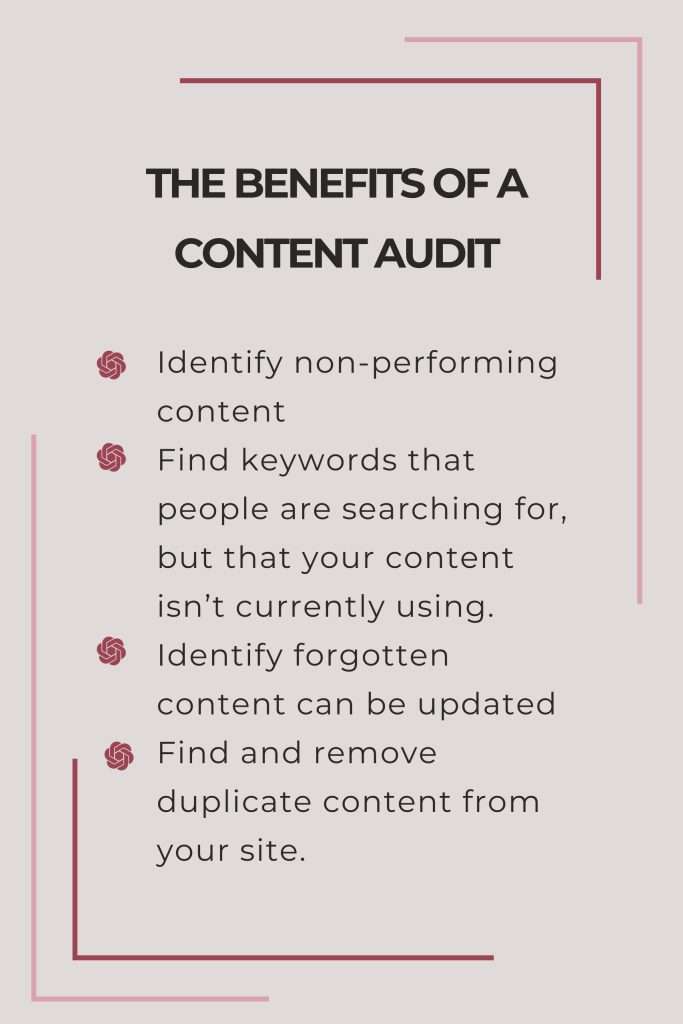
The benefits of a content audit
Content is no longer the king (or queen) that it once was. Google doesn’t want you to have the biggest website. They want you to have the best. The best means that you offer the most value to your reader.
Doing a regular content audit is one way to ensure that that happens. It can help you to:
- Identify the content that’s not getting any traffic. These could be pages that aren’t using the right keywords, have technical issues, or just need a refresh.
- Find keywords that people are searching for, but that your content isn’t currently using. Using these keywords in your existing content will help you to rank higher in search results for those terms.
- Identify forgotten content that just may bring more visitors to your site after a few tweaks.
- Find and remove duplicate content from your site.
Read how Google Search Console can help.
When should you do an audit?

How often you do a content audit is up to you. It will depend on the size of your website, as well as the pace of your industry.
You can review things every 4-6 months or annually.
Auditing your site once per year allows you to gather a year’s worth of data. This helps you to identify patterns in user engagement and content performance. The data can then be used to inform your content strategy for the coming year.
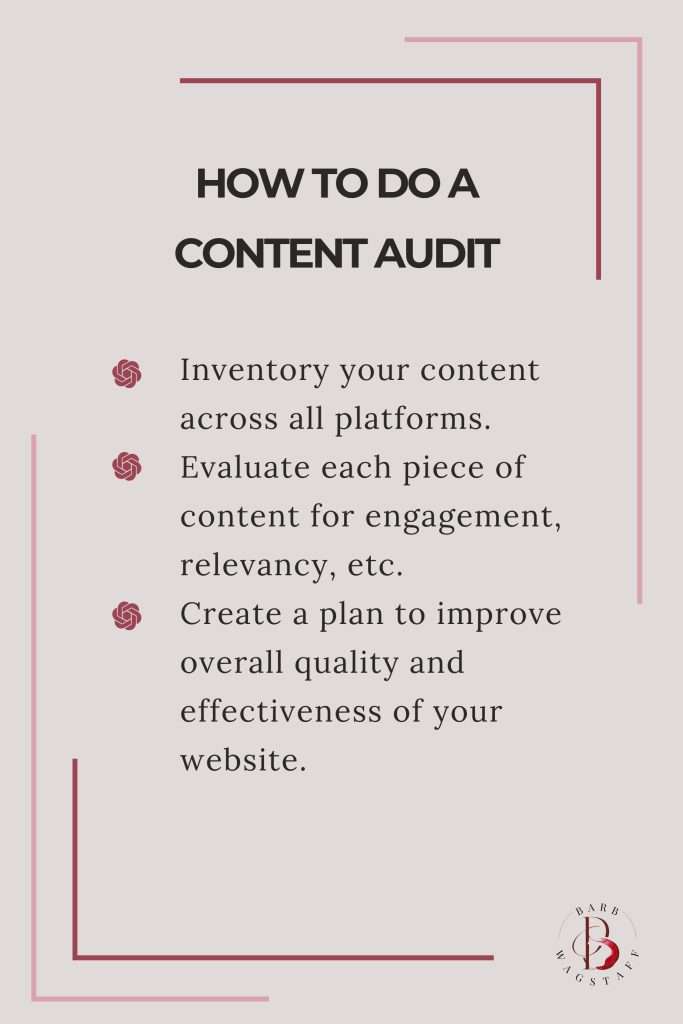
How to do a content Audit
Once you decide on how often you will do an audit, the next step is to dig in. You can either hire someone to help or do the task yourself.
A typically content audit usually involves:
- Creating a comprehensive inventory of all your website content, including blog posts, landing pages, product descriptions, images, and videos.
- Each piece of content is evaluated based on things like:
- How well is it performing in terms of traffic, engagement, and conversions?
- Is the content still relevant to your target audience and current industry trends?
- Does the content include relevant keywords and is it structured in a way that search engines can easily understand?
- Is the content well-written, clear, and easy to understand for your target audience?
- Creating an action plan to address any issues and improve the overall quality and effectiveness of your website content.
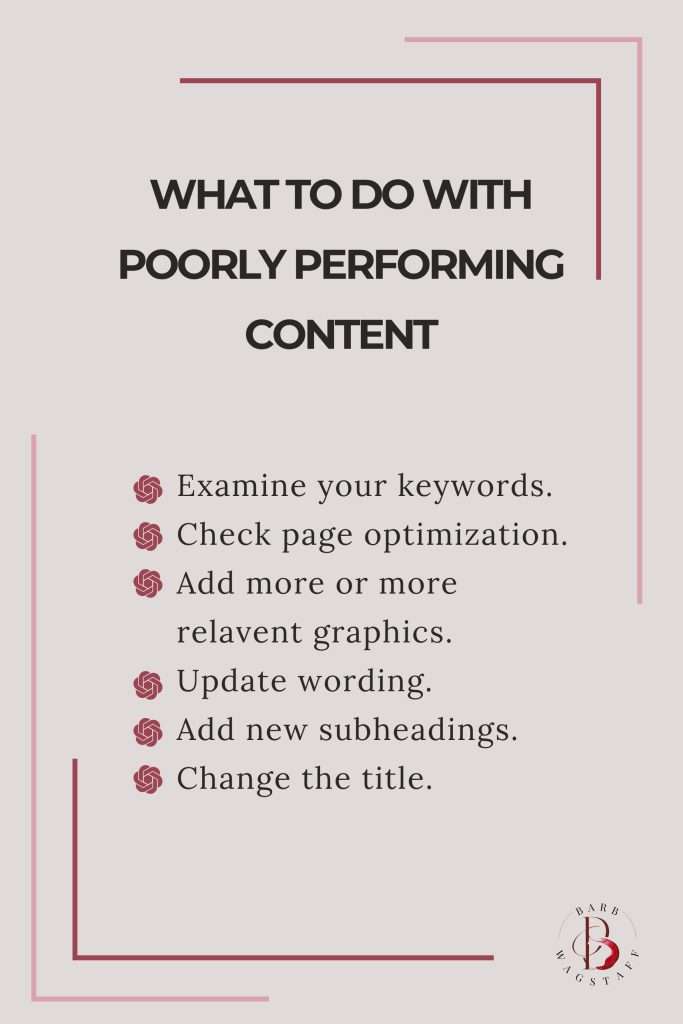
What to do with poorly performing content
Some of your articles may not be performing as well as you think that they should. They are not being seen by 80% of your readers.
You must decide if you can keep the non-performing content or if you remove it.
If the article is relevant and is a fit for your target audience, rework it.
- Examine the keywords that you targeted.
- Make sure that the page is optimized properly.
- Add more or more relavent graphics to your article.
- Update the wording.
- Break the content down into easy to understand sections with new subheadings.
- Change the title to one that will catch the eye of your ideal client.
If you look at an article or webpage and see that it really can’t be saved in its current form, you can:
- Use the content in a social post.
- Use it on a podcast.
- Make it into a pin or reel.
- Share it in an email.
- Make it a downloadable product.
- Place it in a file to be looked at and possibly repurposed at a better time.
If you choose to remove the page, always remember to redirect the file once it is deleted. No one wants to see a 404 error when they land on your page. Redirect your reader to a page that most closely resembles the content that you have removed.
The Goal of a content audit
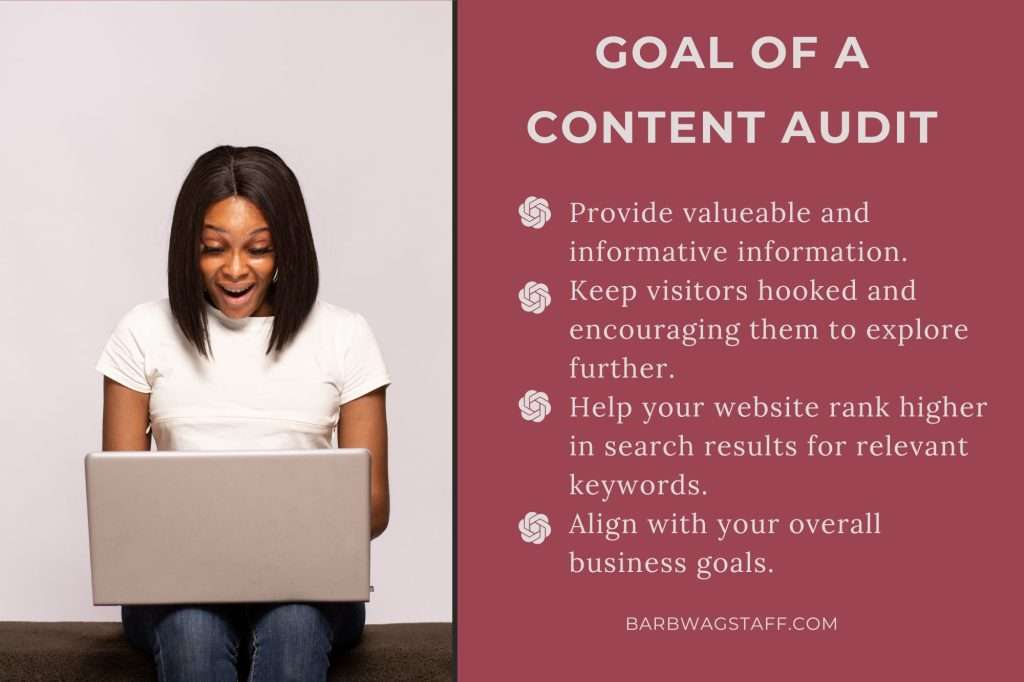
The overall goal of a content audit is to ensure your website content is:
- Providing your target audience with the valueable and informative information that they need.
- Keeping visitors hooked and encouraging them to explore further.
- Helping your website rank higher in search results for relevant keywords.
- Aligned with your overall business goals.
Conducting regular content audits ensures that your website content remains fresh, relevant, and effective in achieving your online objectives.
A content audit is important for SEO.
A regular content audit shows Google that you are providing quality content rather than hosting a lot of pages that are not performing.
Make sure that your top performing pages are always working perfectly, have great CTAs, and have no broken links. This will help to ensure that more of your pages are ranking at the top of search engine results pages.
If you need help auditing your content, book a conversation with Barb.
Watch your website bubble to the top!
Schedule a 1:1 conversation